Pages

Tuesday, July 27, 2010

Terrorising Pakistan: part 2

A guest post by Asif Haroon Raja 


In accordance with the chalked out plan, terrorism was intentionally pushed into Pakistan to destabilize the country. The two extreme flanks of Pakistan , FATA and Balochistan were inflamed to make things difficult for Pak Army, fundamentally poised to guard eastern border. Apart from CIA and FBI gaining a strong foothold in Pakistan under the pretext of chasing and nabbing terrorists’ right up to Karachi , the US Administration increased its influence inside Pakistan so comprehensively that Boucher and Negroponte started to micro manage its domestic affairs including local bodies’ elections and 2002 general elections and reduced the parliament into a rubber stamp. American intelligence agencies helped RAW to make inroads in trouble spots.    
Pakistan was first harried on account of nuclear proliferation in 2004. Hue and cry was made over AQ Khan Network, and Iran and Libya put under intense pressure to establish a connection. Although Pakistan refused to make available Dr AQ Khan for interrogation after he made a public confession under duress, Pakistan inadvertently accepted that nuclear proliferation had taken place. It assured USA and IAEA that network had been effectively disabled. Pakistan thought that the matter was closed but it was never let off the hook and its nuclear program came under unceasing vicious smear campaign.
After 2005, The US began to change colors and became more intrusive and difficult. This change occurred because of resurgence of Taliban in southern and eastern Afghanistan , development of Gwadar Port with Chinese assistance, Iran-Pakistan gas pipeline project, and Pakistan economy getting robust. Pakistan was whipped by USA , India and even landlocked Afghanistan holding it responsible for their difficulties in Afghanistan. Pakistan bore the pain of whips and degradation to ensure US support and flow of US dollars. Pakistan kept chasing the faceless enemy without a comprehensive plan, intelligence, low intensity conflict training, counter terrorism equipment and motivational program. These shortcomings became serious impediments in tackling terrorism and allowed the Tehrik-e-Taliban to gather strength and expand its influence.
Having sufficiently embroiled the Army in war on terror and weakened its institutions the US started to inch closer towards achieving its goals and became more demanding. It repeatedly asked Pakistan to do more without compensating it for the immense sacrifices it was rendering. Instead of rewarding Pakistan for taking the main brunt of war on terror, the US rewarded India in the form of lucrative civil nuclear and defence deals, well knowing that instead of curbing terrorism India had inflamed it through covert means. Ironically Pakistan didn’t raise even an eyebrow on this grave development. Its lackadaisical stance resulted in materialization of Indo-US nuclear agreement in 2008.
After vainly trying to put the ISI under Ministry of Interior in August 2008, the US exerted extreme pressure on Pakistan leadership to let its military intrude into FATA. Several aerial raids, artillery fire and a ground attack in Angoor Adda in September 2008 were carried out. These blatant intrusions indicated American growing impatience and their desperation to directly meddle in Waziristan . While Pakistan gave its tacit approval to drone attacks since this understanding had already been given by Gen Musharraf, Pak military under new commander Gen Kayani did not agree to the proposal of joint operation or any unilateral action and took a firm stand. Had this proposal been ceded to, it would have amounted to allowing the head of a camel to enter the tent. Entry in FATA would have encouraged US military to keep creeping forward and to gradually envelope whole of Pakistan under the pretext of striking non-state actors. Mention of Quetta , Peshawar and Karachi as hiding places of high profile terrorists and main base of Al-Qaeda in FATA and Taliban Shura in Quetta exposed its intentions.
While attitude of US officials became belligerent, Indo-Israeli-US propaganda campaign became fiercer. Mumbai drama was stage managed on 26 November 2008 to give an excuse to India to heat up eastern border. Throughout 2009 India remained in a highly offensive mood. Pakistan’s policy of appeasement was taken as sign of weakness and subjected to unabated pressure to make Pakistan agree to Indian unfair demands of proceeding against suspects without evidence and to dismantle Indian specific terrorist network. The US instead of acting in a fair and unbiased manner brazenly supported Indian stance.
None of the accusers took into account the hard fact that Pakistan had suffered as no other country in the world had from foreign sponsored terrorism. Its economy suffered a loss of over $45 billion and it lost over 8000 lives in the blowback of the militants in retaliation to military operations. Pakistan bore maximum brunt of foreign sponsored terrorism during the years 2008-09 and is still suffering. After targeting Peshawar incessantly, Lahore is the current target of RAW. From March 2009 onwards, dozens of terrorist and suicide attacks have taken place in capital city of Punjab and hand of RAW was visible in each incident.
Slight change in Indo-US-Afghan belligerence occurred after Pak Army’s successful fight against well-entrenched militants in Malakand Division, Swat, Bajaur and South Waziristan (SW) at a heavy price. These successes were achieved at a time when nothing was going right in Pakistan . Political situation was in a mess, economy had become fragile, law and order had worsened and Pak Army’s image had been badly dented due to an orchestrated smear campaign. Pakistan was being viewed as a failing state unable to protect its nuclear assets. Stories of balkanization or break up were in circulation and a very gloomy picture was painted. It was propagated that Pakistan’s security forces were incapable of fighting the militants and protecting nuclear assets. US Special Forces started to fine tune their contingency plans to take away the nukes before falling into wrong hands. Indian strike formations had taken up a forward posture and Indian military had started beating drums of war.
It was under such daunting challenges that Pak Army fully supported by the government and the public turned the tide and blunted coordinated external and internal onslaughts and left the detractors gaping with wonder. CIA-RAW-Mossad supported Tehrik-e-Taliban Pakistan (TTP) is on the run; its liberty of action is curtailed. During the operations, the Army came across irrefutable evidence of involvement of RAW in all the restive regions. Besides arresting Hindu RAW agents, some disguised as Taliban, heaps of Indian origin weaponry was captured. Israeli made Uzi weapons and telescopic rifles were also found. It was a surprise to find highly encrypted communication system in use of TTP which could not be intercepted but could jam and listen to Army’s telephone/wireless network. Mossad had provided Israeli made specially designed transmitters for FM radios to Fazlullah which played a key role in expanding his influence in Swat and Malakand Division?
In June 2009 when Pak officials confronted Washington with evidence that terrorists in Pakistan were using sophisticated American weapons, the US media quickly leaked stories about US weapons missing from Afghan National Army. The figure of losses ran into thousands and it couldn’t be that ANA soldiers were operating without weapons or with locally manufactured weapons without being noticed by superiors.
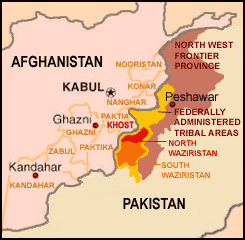
No sooner was TTP base routed in SW that the US started exerting pressure on Pakistan to mount another offensive in North Waziristan (NW), painted as epicenter of terrorism. Several RAW created terrorist groups including Asian Tigers and some runaways of TTP have sprouted in NW to create anarchic conditions. Gen Kayani has rightly remained firm that no further stretching into NW till full consolidation of Swat and SW, which includes rehabilitation of IDPs, rebuilding of destroyed infrastructure and transfer of power to civil administration. For this he needs expeditious delivery of promised funds. He has also desired speedy delivery of counter insurgency equipment for achieving long term tangible results.
148,000 troops are already committed in FATA and Swat. Army cannot afford to further thin out troops from eastern border as long as Indian intentions are hostile. India has so far not closed training centres and Pakistan specific consulates in Afghanistan wherefrom covert operations are being launched. The US has been told that Pakistan would not like any military role for India in Afghanistan including training of ANA after the departure of US-NATO troops. Kayani prefers training of Afghan security forces by Pakistan Army. This has been partly agreed to and hopefully Afghan officers would be sent to attend training courses in various schools of instructions.
Pakistan has also been urging Washington to facilitate settlement of disputes with India . While little headway has been made on Pakistan ’s requests, the US is relentlessly asking Pak Army to speedily jump into boiling cauldron of NW irrespective of consequences. Hilary Clinton, Holbrooke and Adm. Mike Mullen are fixated on NW and have hinged successful outcome of Afghanistan war on neutralization of NW. All three in quick succession have issued tough statements to maximize pressure on Pakistan . They see Osama hale and hearty living in Pakistan . Minuscule Haqqani network and diminutive Lashkar-e-Taiba are being portrayed as most dangerous monsters. As a super power, the US should have felt ashamed in even making a passing mention of these insignificant entities. But such are the ways of bullies who by design project a Lilliputian into a Gulliver.
The US rules out scope for negotiations with Haqqani network in NW whereas it has given a blank cheque to Karzai to hold negotiations with Taliban and has not put any pressure on Gen Petraeus as to why he is not expediting operation against Kandahar. Instead of making some headway, visitors from 27 countries in Kabul were given fanciful news that ISAF would be able to hand over security of Afghanistan to ANA by 2014. While remaining fixated on NW, the US is least concerned about fast deteriorating security situation in Balochistan and Karachi where RAW and Blackwater in concert with local anti-state elements are actively involved in target killings. It betrays US sincerity of intentions.
Brig Asif Haroon Raja is Staff College and Armed Forces War Course qualified, holds MSc war studies degree; a second generation officer, he fought epic battle of Hilli in northwest East Bengal during 1971 war, in which Maj M. Akram received Nishan-e-Haider posthumously. He served as Directing Staff Command & Staff College, Defence Attaché Egypt and Sudan and Dean of Corps of Military Attaches in Cairo . He commanded the heaviest brigade in Kashmir . He is multi-lingual and speaks English, Pashto and Punjabi fluently. He is author of books titled ‘Battle of Hilli’, ‘1948, 1965 & 1971 Kashmir Battles and Freedom Struggle’, ‘Muhammad bin Qasim to Gen Musharraf’, Roots of 1971 Tragedy’; has written number of motivational pamphlets. Draft of his next book ‘Tangled Knot of Kashmir ’ is ready. He is a defence analyst and columnist and writes articles on security, defence and political matters for numerous international/national newspapers/websites. Email: asifharoon7751@yahoo.com
Tailpiece


This article was first published at the 'People of Pakistan' blog on 26 July 2010. This article touches on some of the issues I raised in my last blog post and it introduces some new ones. I do not necessarily agree with everything that Brig Asif Haroon Raja says but I do think that he raises important issues which need to be more widely known. 


You can see the original article by clicking here.

Wednesday, July 14, 2010

Terrorising Pakistan

A conspiracy of silence.

Already this year there have been five deadly attacks in Pakistani cities resulting in the deaths of hundreds of innocent Pakistanis. The most recent act of savagery occurred on 9 July in Mohmand in the North West of Pakistan, close to the border with Afghanistan, when over 100 ordinary citizens lost their lives and some 200 were injured (see Tailpiece for a full list of attacks since 2007). This crude suicide attack is clearly the work of “Pakistani Taliban”. Other attacks, requiring considerable planning and a degree of sophistication, point to an altogether more sinister and better organised presence in Pakistan.

The head of Pakistan’s Inter Services Intelligence, Lt. Gen. Ahmed Shuja Pasha, gave a briefing to the Parliamentary Committee on National Security last week, which told a tale of foreign intrigue and sinister collaboration between an ostensible “friend” and a sworn enemy of Pakistan. The complicity of foreign states in the sort of terrorist activity that we have previously witnessed in Iraq and Afghanistan has been an open secret for a long time. It is good to see someone in authority acknowledging it at last. But we need to go further and shout the reality underlying terrorism in Pakistan from the rooftops – speak up boldly at international forums and provide the incriminating evidence, though it will inevitably incur the wrath of the USA.

In Pakistan itself a strange silence hangs over the country. Save for a few brave souls in Pakistan’s journalistic community, and some outspoken politicians such as Imran Khan, people who occupy influential positions in Pakistani society have either sealed their lips or they deflect all suspicion on to Pakistani Taliban, shielding the stars of this macabre drama of murder and intrigue. Many of Pakistan’s top politicians and functionaries are neck deep in corruption and various fraudulent acts, which makes them susceptible to blackmail. Others are bought off with a combination of monetary bribes and threats of violence. Generally, there is little honest attempt at analysing Pakistan’s complex, rapidly changing situation and relating it to preceding events.

Separating reality from illusion

Let us take the three most recent attacks to see if there is a pattern we can observe. 

1.  The massacre of Ahmadis in Lahore
On 28 May a group of people attacked two mosques belonging to the Ahmadi community at a time when they were overflowing on the occasion of Friday prayers. Some 90 members of the congregation died and as many as a hundred were injured. Immediately, Pakistan’s westernised “intellectuals”, with pockets and hand bags bulging to bursting point with wads of American dollars, declared that the attack amounted to inhuman persecution of the Ahmadi community, blah blah blah. That the Ahmadis are indeed a persecuted minority in Pakistan is a well known fact but linking a terrorist attack to such persecution showed that a conscious attempt was afoot to deceive Pakistanis about the origin of the terror unleashed on them. As you can see from the Tailpiece, this attack was simply one of a series intended to terrorise and destabilise Pakistani society. My own response to this atrocity was given in my blog post Self destruction of Pakistan, and in comments elsewhere:

“……… please remember that the tragic loss of life on Black Friday was not the result of sectarian violence. It was an attack by sub-human creatures who had previously murdered Pakistanis of all religious denominations.

The situation in Pakistan is so warped at the moment that it is difficult to understand what is going on. The horror story that is being acted out on the vast Pakistani stage can be witnessed by all but the hands directing this nightmarish scene are hidden from view. Hence the preponderance of what some people have termed "conspiracy theories", a most unfortunate term that discourages people from uncovering the ugly truth.

At several blogs run by Pakistan's self-styled "liberals" this tragedy has been used as a ploy to divert attention away from other issues of great national importance. I have felt sickened by the hypocritical public chest beating of these liberals, some of whom clearly have ulterior motives. What conclusion can you draw when people start suggesting that Pakistanis should focus only on their internal sectarian problems - on this occasion, at least, it is NOT a case of sectarian violence - and stay away from protesting against Israel's murder of Turkish citizens taking relief supplies to Gaza!”

2. The massacre at the shrine of Ali Hajveri, “Data Ganj Bakhsh”, Lahore
This occurred on Thursday night, 1 July, when the shrine was full of devotees of the saint. A single suicide bomber killed himself and some 45 others, and some 200 people were injured. There have been reports of suspicious foreigners taking photographs of the Data Darbar shrine some days before the suicide attack.
 
 Once again, the westernised chattering classes of Pakistan have had a field day, talking loudly about religious intolerance and sectarian strife. Very cleverly, two new phrases  ‘religious intolerance’ and ‘sectarian violence’ have replaced ‘religious persecution’ this time. As before, the real culprit behind the wicked deed is cleverly covered up.

There seems little doubt that there is a conspiracy to refuse to analyse and investigate each deadly act of violence and to draw appropriate conclusions. This, in my opinion, shows the extent to which the USA agencies have managed to deflect suspicion away from their own anti-Pakistan activities towards the dormant cancer of sectarian hatred that blights Pakistani society.

3. The massacre of Pakistanis awaiting rehabilitation in Mohmand Agency (North-West Pakistan)

Close to the Pak-Afghan border, this is an area where “Pakistani Taliban” - an organisation which owes its birth to American patronage - had earlier been defeated by the Pakistan army and they had escaped further north. The army had declared the area to be safe from Taliban and the government was asked to arrange for the return of people who had been displaced by the fighting. The government responded by telling the people to return but it made no effort to establish a viable civic administration to offer security to people going back to their ruined towns.

On 9 July the unfortunate souls awaiting re-settlement were mercilessly cut down by two suicide bombers, in a car and on a motorbike. Over a hundred people died and some 200 sustained horrible injuries. This attack was launched by Pakistani Taliban as a revenge for their earlier defeat.

The hands of the murderers

There are three distinct pairs of hands:

1. The Pakistani Taliban, who carry out atrocities in places like Mohmand. They are an obvious target, and they are being pursued relentlessly by the Pakistan army.

2. Pakistan’s avowed enemy India, which has been given a free hand by our treacherous friend in Afghanistan, the mighty USA. The Indian influence in Afghanistan is massive – Indians are said to work closely with Afghanistan’s “Northern Alliance” and with the Israeli experts in urban terrorism. To understand it fully requires a separate article – suffice it to say that India, which forcibly occupies Kashmir by stationing a huge army there numbering 700,000, is delighted to help the USA destabilise Pakistan. The Indians in Afghanistan finance, train and provide sophisticated weapons to mercenaries and Taliban, who are then sent over the Pak-Afghan border to attack pre-determined targets. The USA, which is supposed to maintain high tech surveillance of the long Pak-Afghan border, is a willing accomplice in these dastardly terrorist operations.

3. The vast presence of the USA operatives, contractors and mercenaries in Pakistan (CIA agents and those belonging to Dynacorp and Blackwater/Xe Services). It is these who are suspected of planning and executing attacks in the large cities such as Lahore and Rawalpindi.
 
A historical perspective

What we have to ask is: who will benefit from the spread of terror and insecurity in Pakistan? Pakistan's descent into hell has been preceded by similar experiences in two places: Iraq and Afghanistan. What is the common factor between them? You don't need rocket science to work that out - all you need is simple common sense and some basic honesty.

The USA government is adept at launching “false flag” operations. An utterly obscene example of this “art” was the staged farce of 9/11, which was promptly linked to backward Afghanistan though no evidence has ever been produced, then or since. To deceive the world about the 9/11 outrage, the USA government destroyed all evidence of that heinous crime against humanity. They then spun a weird tale which defied the facts and gave rise to a whole industry devoted to unearthing the truth about 9/11.

The Americans swung their formidable propaganda machine into action, responding to all criticism by rubbishing it as “conspiracy theories”. In 2002, when the USA appeared to have Afghanistan in the palm of its hand, George Bush’s White House aide spoke the chilling words which revealed the real intentions of the neoconservatives surrounding Bush:

“We’re an empire now, and when we act we create our own reality. And while you’re studying that reality – judiciously, as you will – we’ll act again, creating other new realities, which you can study too, and that’s how things will sort out. We’re history’s actors …. and you, all of you, will be left to just study what we do.”


Since then the USA’s “false flag” operations have multiplied. Iraq is a good example, where the targeted killings of Shias were used to inflame passions against the Sunnis, and vice versa. The internecine violence weakened the Resistance against the occupiers and the USA government claimed a pyrrhic victory.  The architect of that strategy, General David Petraeus, is now trying out his evil schemes in Pakistan. He is clever enough to recognise that, unlike Iraq, Pakistan has a free press and he has to muzzle journalists by bribing them heavily.

Remember that Americans are roaming all over Pakistan, among them Urdu and Pashto speaking “contractors” and CIA agents. A compliant Pakistani government, installed by the Americans under a false façade of “democracy”, issues visas freely to Americans in accordance with the demands it receives from the USA government.

Though Pakistan is not a desperately poor country, the lack of governance and general mismanagement of the country’s resources, have produced a perilous situation where families routinely suffer starvation and dishonour. It is not uncommon to hear of whole families committing  suicide. There is thus a vast pool of people from which the sinister foreign presence in the country can recruit willing suicide bombers.

The ugly reality

Let us learn to think critically: what you see may only be an illusion, hiding an ugly reality underneath.

 That ugly reality behind the attempts to terrorise the civilian population of Pakistan is the increasing USA pressure on Pakistan to send its troops into North Waziristan and attack the Afghan Resistance to USA occupation from the Pakistani side of the Pak-Afghan border. Since an action in North Waziristan will trigger a civil war in Pakistan, a second aim is to destabilise Pakistan and to weaken its army, which will enable the USA to take possession of Pakistan’s  nuclear arsenal, and India to gobble up Kashmir (where India's occupation army has gunned down 17 youths recently).
  
The Americans have been in Afghanistan nearly 9 years and, by all accounts, they are staring defeat in the face. To put things in perspective the number of Americans who have died in this totally unnecessary conflict stands at a little over 1000 while the Nato forces have probably suffered under a thousand casualties. To the Americans these are very high figures and they are putting pressure on Pakistan to get its army to do the fighting for them. Pakistani lives, it seems, are dirt cheap when it comes to achieving the evil designs of USA politicians, who do not acknowledge that Pakistan army’s loss so far is several times that of USA’s. 

Pakistan’s servile obedience to the USA’s war aims has resulted in the loss of thousands of our soldiers and our citizens, and it has brought us close to financial ruin. Having lost so much already as a “friend” of the USA, what more is there for us to lose? Let us, for once, sample the blessings that will ensue from breaking that bond of enforced friendship.


Tailpiece

The following is a list of major attacks since July 2007 [source: The Nation, 9 July, 2010]:


2007

July 19: Three suicide attacks in the northwest of the country kill 54 people, including more than 20 soldiers and police officers.


October 18: Bomb attacks targeting two-time former premier Benazir Bhutto kill at least 139 people in Karachi, just hours after she returned to Pakistan for the first time in eight years. She survives unhurt, but is killed along with around 20 people in another gun and suicide attack on December 27.


December 21: At least 56 are killed in an attack on a mosque in the northwest of the country.


2008

August 21: Twin suicide attacks kill at least 64 people outside Pakistan's main arms factory in Wah, near Islamabad.


September 20: At least 60 people are killed when a suicide attacker rams a massive truck bomb into the gates of the five-star Marriott hotel in Islamabad.


2009
October 28: A massive car bomb destroys a Peshawar market crowded with women and children, killing 125 people.


December 7-8: Four attacks, including two almost simultaneous blasts on a market in the eastern city of Lahore, leave at least 66 dead.


2010

January 1: A suicide bomber blows up a car packed with explosives in the middle of a crowd gathered for a volleyball game in a northwest village, killing at least 101 people.

March 12: Twin suicide attacks seconds apart target the Pakistani military in Lahore, killing 5.


May 28: Gunmen wearing suicide vests storm two mosques belonging to a  minority sect in Lahore, bringing carnage to Friday prayers and killing at least 82 people.


July 1: At least 43 people are killed when suicide bombers strike at the tomb of an Islamic saint in Lahore.

July 9: Two suicide bombers blow themselves up in a crowd of people in a busy market in Mohmand district, killing over 100 people and wounding some 200.


Thursday, June 24, 2010

Feminists join mullahs in making Islam irrelevant


Imamahs leading mixed congregations of the faithful.

On 10th June a report appeared in a British newspaper, The Independent, under the heading “First woman to lead Friday prayers in the UK”. The opening line of the report began, “A Canadian author will become the first Muslim-born woman to lead a mixed-gender British congregation through Friday prayers tomorrow”. Very helpfully, the newspaper published a picture of a mixed congregation with the imamah, Raheel Raza, sitting at the front.


Slightly tongue-in-cheek, I sent off a comment which was published at the newspaper’s website:


“Given that people who lead prayers in mosques are often self-regarding, unpleasant individuals, we should be talking about reforming the way prayers are conducted. Talking about appointment of imamahs is really a non-issue, at best a ridiculous imitation of the practices recently introduced in some religions.


The basic point that we need to grasp is that Islam is NOT a religion. It is a Deen, a Way of Life, a System, that we have to observe in our daily lives. When we remember Allah, our attention needs to be directed to Him alone, cutting out all distractions. Islamic prayers are not like Christian prayers where women sit demurely by the side of men. In Islamic prayers you rise and bow and prostrate, and you may become so absorbed in the remembrance of Allah that you become forgetful of proper decorum. If we have a mixed congregation it would become impossible to let go of our inhibitions and lose ourselves in the Zikr. It will be very difficult indeed to forget the presence of a member of the opposite sex near you as she/he rises from a prostate position and your eyes - inadvertently, of course - come to rest on the undulating form as it straightens up”.


Four days later The Guardian, another British newspaper, carried an article by Shaista Gohir (Gohar?) titled, “Women must be leaders in faith”. The full article is given below.

Women must be leaders in faith

A woman led Muslim prayers in Oxford last week. Her actions and those of others like her, across faiths, deserve our support


Shaista Gohir                                           


guardian.co.uk, Monday 14 June 2010 13.30


So far, it seems only Muslim women from abroad dare lead men in Friday prayers in the UK. A Canadian, Raheel Raza, became the second Muslim woman to do so at the Muslim Educational Centre in Oxford last week. An African-American convert, Amina Wadud, was the first Muslim woman to lead mixed prayers at the same centre in 2008. It's not surprising that British Muslim women are not brave enough to follow their footsteps – both have been demonised after leading men in prayers in their own countries.


Why is the idea of female imams so controversial amongst many Muslims? When Amina Wadud shocked the world in 2005 by leading mixed-gender Friday prayers in New York, I must admit even I felt uncomfortable. I had been brought up to believe only men could be imams, something I never questioned until recently.


An honest study of Islamic texts reveals that women are not forbidden to lead men in prayer – the Qur'an does not even address this issue. In fact the conditions required are Islamic knowledge, skill and piety – none of which are gender related. However, (mostly male) scholars maintain there is consensus on the impermissibility of women leading men in prayer despite lack of evidence to back up their position. In many quarters, this issue is not even open to debate, despite the fact that centuries ago it was discussed without controversy and a diversity of opinions was respected. According to female scholar Halima Krausen, a number of male scholars, such as Abu Thawr al-Kalbi, Abu Isma'il al-Muzani, al-Isfahani, at-Tabari and Ibn Taymiyya, had nothing against women leading mixed prayers. One woman, Umm Waraqa, is known to have led men in prayers in her household during the time of Prophet Muhammad.


Male clergy often cite questionable hadiths or take them out of context to criticise women such as Wadud. One argument often marshalled is that women's bodily movements arousing desires in men. Are men really so weak that they can't keep their eyes off a fully covered woman's posterior during prayer? I believe men have invented arguments about their sexual excitement – it is only their ego that prevents them from praying behind a woman.


Despite these powerful arguments supporting the permissibility of women leading mixed congregation prayers, I doubt the practice will become widespread in the near future as religious institutions are controlled by men. And most Muslim women are more concerned about fighting for equality on basic grounds such as education and economic empowerment. I don't think leading prayers is a battle that many are yet ready to fight, even if they believe in it. But Wadud and Raza are paving the way for more female imams to come forward to lead other women in prayer. Last year Hawaria Fattah became the first female imam in Europe after being recruited to a mosque in Belgium. This is a pioneering appointment even though she only works with Muslim women.


Restricting women's role in religious structures and practices is not exclusive to Islam. Historically all the world's major religions have done this. The first female rabbi was Regina Jonas, who was only ordained privately in 1935 in Berlin. The next ordination came in the US, in 1972, when Sally Priesand was made a rabbi in the Reform tradition. Since then, all branches of Judaism, except Orthodoxy, have found a way to ordain women.


Female priests may have been ordained in various branches of Christianity. However, its largest denomination, Roman Catholicism, has consistently refused to allow women into the priesthood. Those ordained unofficially are often excommunicated. This status quo continues to be challenged – last week a group marched to St Peter's Square demanding a debate on this issue. Opening the doors to the priesthood would mean women could ascend to the papacy – and perhaps the possibility of a future female pope is too much for the Catholic church.


Women are suffering the consequences of oppressive misinterpretations of religious texts in all faiths. It's time more of us questioned their legitimacy. No topic should be out of bounds for discussion, including the question of female religious leaders. The act of attempting to break down the last barriers to female participation sends an unequivocal message about equality.

============================
On reading this article I responded with the same comments as those I had made earlier in connection with the article in The Independent. I also gave a link to my blog. The author’s response, published at the website on 15 June, was:

“You have nicely illustrated my point about men making excuses about how easily they are supposedly aroused and distracted. If you are that deep in prayer, nothing should distract you. And if you have sinful thoughts, then why should women pay the price for being excluded? Shouldn't men be the ones excluded into another room who have such thoughts.


You conveniently forget to mention verse 24:30 in the Quran which commands men to lower their gaze. The Qur'an does not even remotely suggest that men are sexually more excitable than women. In fact I have discovered the following hadith which is conveniently ignored: “God has created the sexual desire in ten parts and he gave nine parts to women and one to men.” The same narration goes on to say, of shyness, women have been given nine parts of that too. So if women can control all nine parts of their desire when men are bending in front of them, sometimes wearing the tightest of jeans, it’s about time men took responsibility for their own urges too, and not hold women responsible.


So if you are having bad thoughts, please take responsibility.


I know there are many criticisms on here about all religions being patriachal 
which is true..........but they would be less so if more women were involved, especially in leadership roles. So even if you are against any form of religion, surely women's increased involvement is a good thing.”

Clearly we were not on the same wavelength. Ms Gohir, I could see, had read widely and she could take on most mullahs in a discussion on Islam as religion. Only, to me, Islam was not a religion and the feminists were making the same mistake that mullahs had made earlier. I carefully composed a reply:


Dear Ms Shaista Gohir,


Words are an imperfect means of conveying deeply held convictions. The way we use words, and interpret them, tend to reflect our own experience and it is easy to misunderstand another person’s point of view.


You talk about “sinful thoughts” – I am not sure what you mean. Do you have any control over the random thoughts that might occur to you? There are times when we think consciously and there are other times when thoughts just descend out of nowhere. Is a person responsible for the latter kind of thoughts?


The points I was trying to get across were:


1. There is no concept of priesthood in Islam that Muhammad Mustafa gave to mankind 1500 years ago. Having a priesthood is a distortion of Islam – a practice picked up from the Jews and the Christians.


2. In the early years of Islam mosques were not just places of worship – they were also what we might today call ‘community centres’, where the problems of the community would be addressed. The Caliph himself, or other leaders of the community, would be present to offer prayers to Allah and then to seek His Guidance in solving the problems of the community.


3. The kind of “worship” that is offered in the mosques today is, in my opinion, of very little value. I doubt if you have attended many prayer sessions or listened to the sermons that the Muslim priests deliver. Most are impractical and have been devalued through repetition. You will rarely hear anyone addressing the ills of so-called Muslim societies, which are anything but Islamic: widespread corruption, lies and deceit; and exploitation/ oppression of the general population by the privileged classes on a massive scale.


4. Remembrance of Allah is unlike anything else we might do. To receive and feel His Power within our ‘selves’ we need to reduce all kinds of distractions as much as possible and that means minimising the activity of our thinking mind. Thus, for example, the music that is played in many places of worship is considered inappropriate when it comes to remembering Allah. A direct link between the Creater and a created being is not dependent on such props [“He is closer to us than our jugular veins”]. It is in this sense that I consider men and women praying alongside each other to be a negation of true worship – simply because they will be too aware of each other’s presence and their minds will remain active - this has nothing to do with "sinful thoughts". I am sorry for the rather flippant comment I made in my previous post. However, I wasn’t just referring to men – my comments applied equally to women:


“It will be very difficult indeed to forget the presence of a member of the opposite sex near you as she/he rises from a prostate position and your eyes - inadvertently, of course - come to rest on the undulating form as it straightens up”.


I think you would appreciate my point of view better if you were to read the very first and the very last posts in the blog to which I provided a link. Would it be OK to use your article, and some of the comments thereon, in a future blog post? I don't suppose there will be any objections from the Guardian, which will be duly acknowledged?

Ms Shaista Gohir responded as follows:


"Thank you for such a detailed response. I will check out the links you have provided. And yes you should use my article to create debate whatever your take is on this. I think this issue should not be out of bounds and debated without it becoming too polarised which it did become back in 2005, when Amina Wadud first hit the headlines.


If men disagree and don't want to pray behind a woman for whatever reason then they shouldnt have to. However, they should not imply it is because of divine will and just be honest that it is simply male opinion on this issue. Likewise a woman should not have to accept the status quo and be able to challenge practices that she feels are man made without being demonised.


In terms of priesthood, I agree, in Islam we are not supposed to have intermediaterie between us and God and we give too much blind obedience to scholars / imams without checking out religious texts for ourselves."


I felt Shaista Gohir hadn’t quite appreciated the reason why I felt it served no purpose for men and women to offer prayers standing next to each other. It seems to me that the feminists have entered into a race with the mullahs to convert Islam into a meaningless religion similar to what Christianity has become. The feminists are trying to widen the mass of rituals we have today instead of cleaning up the mess and sending the mullahs packing from the mosques. I would be very happy if Shaista Gohir would deliver a Friday khutba about the plight of women in “Muslim” countries or about something else she feels strongly about. However, she should not then try to herd men and women into a room and get an imamah up front to “lead” them in prayer.

Thursday, June 10, 2010

ISLAM: the Reality beyond time and space


La ikraaha fid-Deen [Al-Qur’an, 2:256].
There is no compulsion in matters of Religion

In my article on Islam and, especially, the discussion that followed - Islam: back to basics - I touched on the differences in the interpretation of Quraanic aayaat which can arise among scholars of great repute and intellectual attainments. I think this aspect of the world of Islam requires a bit of amplification.

First, consider this excerpt from my aforementioned article:

“Unlike Allah’s Messenger Muhammad, who was a practical man of the world just as much as he was a Knower of the Reality which transcends the material world, these so-called ulema know neither this world nor the wider Reality.”

Muhammad Rasul-Allah, Rehmatul-lil-aalameen, was not an intellectual, he did not go to any university, nor did he write a book. Yet he had all the wisdom in the world and he was able to act as a ruler, a judge, a military commander and a spiritual leader. He had understanding of this material world, and also of the world of non-matter, because of the Knowledge and Guidance he received directly from The One, The Everlasting, The First and The Last. That knowledge did not depend on the cleverness of the mind nor was it affected by the limitation of human powers.

When we move beyond the Messengers to lesser mortals the difficulty we face is that most of them rely mostly on the power of their intellect, the cleverness of the mind – which cannot directly grasp the truths that exist in the world of non-matter. Thus, where there is no guidance from a Higher Source one’s interpretation of the Qur’an cannot be faultless. That, I think, is why differences of opinion occur between equally sincere seekers after the truth.  

The mind is a material thing and it will die with the death of the body. What will survive death is the real “I” - in Quraanic terminology, “the Nafs” - which transcends matter. Thus, unless a person has been touched at that deeper level from a Higher Source his knowledge cannot be said to be complete. Each person is unique, people differ widely with regard to their physical, intellectual and spiritual capacities. A spiritual giant will have a different understanding of the Mutashaabihaat aayaat of the Qur’an compared to someone whose spiritual potential is limited. That is why so many religious scholars possessing great intelligence fail to offer convincing explanations of various Quraanic passages. It may be that Allah is speaking to each person according to his/her capacity and showing a way leading to Him which is right for that person. That may be  why the Quraan declares: La ikraaha fid-deen – there is no compulsion in matters of Deen.

Let me illustrate the point by reference to Iqbal, the poet-sage par excellence, to whom verses descended like “the patter of rain on a tin roof”. Someone who could compose sublime poetry as in Baal-e-Jibreel - people rate Iqbal’s Persian poetry higher, a language I do not know – cannot be an ordinary mortal. There are numerous accounts of Iqbal’s out-of-this-world experiences, which occurred spontaneously and were not self-induced as so many mystical experiences are. In his book “Shahab Nama” Qudratullah Shahab, too, has written about his own spontaneous experiences and he goes on at some length about the inherent risks of Sufi practices, a lot of which depend on props of one kind or another.

In his biography of his father,“Zindah Rood”, Javid Iqbal says that it was Iqbal’s intention to write a book on Islamic Sharia, as he understood it. Sadly, because of the demands on his time, Iqbal was unable to commence this project before it was time for him to move on to the world of non-matter. Had Iqbal been able to write that book, there might have been fewer differences among Muslims subsequently. I say this because a large proportion of educated Muslims of Pakistan acknowledge Iqbal’s position as straddling both worlds, those of matter and of non-matter. Perhaps I am wrong. Many mullahs had indeed declared Iqbal to be kaafir and it is conceivable that in the event of him writing the book that he planned, those attacks might have increased manifold. For me, at any rate, such a book would have been invaluable.

I cannot, of course, judge the spiritual status of Iqbal and Shahab, or of those who are higher still. All I can assert is that, based on my experience, there are people who are endowed with great spiritual gifts. Those who are truly close to the Power of Allah find it easy to live a normal life, outwardly little different from that of an ordinary person. The supreme example of a man conscious of Allah's Power within him, and in everything that exists, was Muhammad Rasul-Allah (R-u-l-A). His appearance conformed to the prevailing fashion, he wore clothes which were normal for the Arab society of his day, and he did not feel a need to cultivate a distinctive look. 

My own approach to understanding the Qur’an is to remain as humble as possible. Possessing neither intellectual nor spiritual gifts, as I read various translations and interpretations of the Qur’an I try also to listen to my inner voice. If that voice tells me that a particular explanation rings hollow then I reserve judgment on that explanation. I try to avoid getting into arguments. I do think that the “inner voice” exists within each human being, only it remains inaudible for most because our wrong actions in this world have the effect of smothering it.

Ahmadi Muslims

Following the massacre on Black Friday, 28 May, I have talked to our Ahmadi brothers and sisters and I have also consulted their literature. Previously, I had known little of the depth of their conviction for their beliefs. I can see now that it is linked to the undoubted mystical experiences of Mirza Ghulam Ahmad. I do not possess the spiritual stature to comment on whether Mirza Sahib correctly interpreted those experiences.

In so far as the Lahori section of the Ahmadiyya movement is concerned they do not see Mirza Sahib as a Messenger in the sense that Rasul-Allah (R-u-l-A) was. The other bone of contention, accepting Mirza Sahib as the Mahdi, is a peripheral issue: Sunnis and Shias have been quarrelling about that for centuries. The only requirement for a person to embrace Islam is: La ilaaha il-lallah, Muhammadur Rasul-ul-lah. If the Quraanic words “La ikraaha fid-Deen” mean anything, we need to restore the legal position of the Ahmadi community to what it was before Z A Bhutto sacrificed it at the altar of political expediency in the nineteen seventies. 

Tuesday, June 1, 2010

The self-destruction of Pakistan....

.... by religious fanatics and USA lackeys.


Religious fanatics

The catalyst for this post is the massacre of Qadianis (Rabwah Ahmadi group) in their mosques in Lahore on 28 May, 2010. About 90 people, including children, died. The responsibility for the killings has been claimed by “Pakistan Taliban”, a monstrous organisation that sprang up suddenly some five years ago. Its origins are steeped in mystery – it is widely suspected of having been a creation of CIA with active support from India. The TTP monster (“Tehrik-e-Taliban Pakistan”, to give it its full title) has now grown out of control – while it still concentrates mostly on self-destruction within Pakistan, it has begun to threaten American interests as well.

The day, 28th May, itself is highly significant. This day is celebrated in Pakistan as the Day of Takbeer, in commemoration of Pakistan becoming a nuclear power in 1998 by successfully setting off nuclear explosions. Those who masterminded the massacre last Friday may have been thumbing their noses at Pakistan, ostensibly a nuclear power but, in reality, little more than a client state of the USA ever since the infamous dictator Musharraf signed away Pakistan's sovereignty in return for American backing to keep him in power. Following the end of Musharraf's long reign, the motley gang of convicts, criminals and fraudsters that succeeded him as the government of Pakistan has done little to improve matters.

Thus, while it is right that we should condemn the massacre of our fellow Pakistanis we should not lose sight of the wider picture. Before targeting Ahmadees, the TTP had been complicit in the mass murder of Shias and in the killings of personnel belonging to Pakistan’s security forces, not to mention indiscriminate bombings of hundreds of fellow Pakistanis of all religious denominations. The ever widening ripples of terror through Pakistani society indicate how the ignorant, ill educated religious fanatics in Pakistan are being used cynically – indeed, in an inhuman, thoroughly diabolical manner – to spread terror and to destabilise Pakistan.

In parallel with the atrocities committed by the religious fanatics, a vastly bigger horror is going on largely unchallenged, resulting in the deaths of thousands of Pakistani citizens.

USA lackeys

The horror referred to in the preceding paragraph comprises the massacres and abductions of Pakistani citizens carried out by ‘educated’ Pakistanis who have seemingly taken an oath of allegiance to the USA. There are three aspects to this obscene collaboration of our westernised Pakistanis with their paymasters in the USA:

1   1. Pakistan’s government and its military are both equally guilty in allowing the USA to launch attacks from the air on Pakistan’s citizens. The ostensible reason for these “drone attacks” (see the fourth paragraph of my my last blog post) is to destroy ‘Taliban’ but the widespread mayhem results in killing mostly the innocent citizens (the death toll splits as 97% innocent citizens, 3% suspected ‘Taliban’). This wanton waste of human life is given the obscene name “collateral damage”!

2   2. By giving birth to the Frankenstein of “Pakistan Taliban” the USA managed to create conditions of civil war in Pakistan, which forced Pakistan’s military to invade the north western areas. This was part of the USA’s ‘do more’ strategy for Pakistan, designed to force this hapless country to sacrifice itself for USA’s war aims in Afghanistan. As a result of military action in populated areas of Pakistan, large numbers of innocent Pakistani citizens have died at the hands of its own military while the damage to property, and the destruction of infrastructure, is incalculable. Flourishing cities, towns and villages have been reduced to places of utter desolation where ghosts might roam. To understand the full horror of what has happened, please click this link:


Quite apart from civilian deaths, the deaths of Pakistani soldiers are many times the number of deaths reported by the USA and British occupying forces in Afghanistan.
        
3. Pakistan’s government meekly issues visas in accordance with the demands it receives from the USA, with little effort being made to check on the people for whom visas are issued. The result is that the country is teeming with USA “contractors” and CIA agents, who come into the country as “advisers” and "diplomats". Over the last several years thousands of Pakistanis have simply disappeared, believed to have been abducted by the ISI (Inter Services Intelligence), many of whom have been handed over to the USA. More recently, though, the ISI’s body snatchers are probably keeping people imprisoned in secret locations in Pakistan, where the Americans are given free access. I have previously written about this shameful episode in the history of Pakistan, which you can read here

In summary, this is the reality of Pakistan today: anarchy, civil war, religious intolerance in a public environment where true Islamic principles are non-existent, an unholy civil-military alliance beholden to the USA, and an uncertain future for its citizens.

All is not darkness, though. Two rays of light remain: Pakistan’s Judiciary, which refuses to bow to the Executive or the Military; and a group of courageous and patriotic journalists who are prepared to criticise the forces which have conspired, knowingly or through foolish acts, to destroy Pakistan. Those who can read Urdu might like to click on the link below to read about the enormous pressure that Pakistan’s press is subjected to at the moment.

Search This Blog

Powered By Blogger